Dossier: Contested Rural Scapes

Authors

  • Cornelia Steinhäuser University of Munster https://orcid.org/0000-0001-5744-8904
  • Aleksandar Lukic University of Zagreb
  • Valerià Paül Carril Universidade de Santiago de Compostela
  • Fernando Ruiz Peyré Austrian Academy of Sciences https://orcid.org/0000-0003-3646-3974
  • Fiona Haslam McKenzie University of Western Australia
  • Aleksandar Lukic University of Zagreb https://orcid.org/0000-0002-7884-5818
  • Facundo Martín Consejo Nacional de Investigaciones Científicas y Técnicas (CONICET). Universidad Nacional de Cuyo

Downloads

Download data is not yet available.

Author Biographies

Cornelia Steinhäuser, University of Munster

Postdoctoral researcher and lecturer at the University of Münster, working in the Applied Landscape Ecology and Ecological Planning group. Her research focuses on agroecology, social-ecological systems, and the role of intangible values in landscape perception and management. She is a member of the Center for Interdisciplinary Sustainability Research (ZIN) and actively contributes to international sustainability initiatives. 

Steinhäuser also co-chairs the IGU Commission on the Sustainability of Rural Systems and collaborates with several academic networks in agroecology and geography. Her work spans multiple regions, including Europe, Latin America, and Africa, reflecting a strong comparative and international perspective. In addition to research, she leads innovative teaching projects that integrate social science and ethnographic methods into landscape ecology. 

Aleksandar Lukic, University of Zagreb

Graduated in geography from the Department of Geography, Faculty of Science, University of Zagreb in 2001 and enrolled in a postgraduate study programme on the geographic basis of spatial planning in the same year. He attended postdoctoral training at the Countryside and Community Research Institute, University of Gloucestershire, UK (2011). He currently serves as the head of the doctoral programme Geography: Space, Region, Environment, Landscape. His research interest mainly focuses on rural and sub-rural areas. He examines the theoretical approaches, typologies, and scenarios of development in rural areas, the regional and spatial planning of rural and suburban areas, and rural tourism and recreation. From the geographic aspect, he has researched the quality of life in city regions, shopping centres and cycling traffic. He is involved in applied research and has led or cooperated on many projects for the European Territorial Observatory Network (ESPON), Central Bureau of Statistics, Ministry of Agriculture, City of Zagreb Office for Strategic Planning and Development, and others. He is co-chair of the Commission for the Sustainability of Rural Systems of the International Geographic Union.

Valerià Paül Carril, Universidade de Santiago de Compostela

Full Professor of Geography at the University of Santiago de Compostela and a member of the Institute of Humanities (iHUS). He holds a PhD from the University of Barcelona, where she specialized in the planning and management of metropolitan agricultural spaces. His research focuses on spatial and territorial planning, with particular attention to protected areas, rural development, and landscape studies. He also works on topics such as mountains, peri-urban regions, food systems, and political and cultural geography, including border studies. Tourism—especially rural and nature-based tourism—is another key area of her expertise. His work adopts a comparative perspective, covering regions such as Galicia, Catalonia, Western Australia, the Iberian Peninsula, and Latin America.

Fernando Ruiz Peyré, Austrian Academy of Sciences

Geographer and Junior Group Leader at the Austrian Academy of Sciences, Institute for Interdisciplinary Mountain Research. He obtained his PhD in Geography from the University of Innsbruck in 2014, after earlier studies in Argentina. His research focuses on social-ecological transformations, human–environment relations, and natural resource governance in mountain regions. He leads a research group addressing sustainability challenges in mountain societies facing global crises such as climate change and economic transformations.

Ruiz Peyré’s work combines interdisciplinary and transdisciplinary approaches, linking scientific research with stakeholders and communities. His regional expertise includes the Andes and the European Alps, with a strong focus on Latin America.

Fiona Haslam McKenzie, University of Western Australia

Works at the University of Western Australia, participating in the Socio-economic research program for the Co-operative Research Centre for Transformation in Mining Economies, based in Western Australia. She also serves as the Deputy Director of Healing Country, an Aboriginal-lead research centre. Her work focuses on regional economic development with extensive experience in population and socio-economic change, mining and the oil and gas industries, housing, and the analysis of remote, regional and urban socio-economic indicators. She currently holds several board positions.

Aleksandar Lukic, University of Zagreb

Graduated in geography from the Department of Geography, Faculty of Science, University of Zagreb in 2001 and enrolled in a postgraduate study programme on the geographic basis of spatial planning in the same year. He attended postdoctoral training at the Countryside and Community Research Institute, University of Gloucestershire, UK (2011). He currently serves as the head of the doctoral programme Geography: Space, Region, Environment, Landscape. His research interest mainly focuses on rural and sub-rural areas. He examines the theoretical approaches, typologies, and scenarios of development in rural areas, the regional and spatial planning of rural and suburban areas, and rural tourism and recreation. From the geographic aspect, he has researched the quality of life in city regions, shopping centres and cycling traffic. He is involved in applied research and has led or cooperated on many projects for the European Territorial Observatory Network (ESPON), Central Bureau of Statistics, Ministry of Agriculture, City of Zagreb Office for Strategic Planning and Development, and others. He is co-chair of the Commission for the Sustainability of Rural Systems of the International Geographic Union.

Facundo Martín, Consejo Nacional de Investigaciones Científicas y Técnicas (CONICET). Universidad Nacional de Cuyo

Researcher at the National Council for Scientific and Technical Research (CONICET) and Professor at the Geography Department of the National University of Cuyo in Mendoza, Argentina. He is Agricultural Engineer from UNCuyo, and holds a Master's Degree in Agricultural Social Studies from FLACSO/Buenos Aires and PhD in Social Sciences from the University of Buenos Aires. Since 2006, he has received multiple scholarships to study in Argentina, Brazil, United States and Germany. He has coordinated international transdisciplinary collaborative research projects (NSF, Lloyd's Register Foundation, IAI, etc.). He investigates agrarian transformations, land and water policts in Latin America. He was recently awarded the Georg Forster Fellowship for experienced researchers of the Alexander von Humboldt Foundation (2024-2025).

References

De la Vega-Leinert, A. C., Kieslinger, J., Jiménez-Moreno, M., & Steinhäuser, C. (2021). Young people’s visions for life in the countryside in Latin America. Geographical Review, 1–25. https://doi.org/10.1080/00167428.2021.1925897

Ives, C. D., Freeth, R., & Fischer, J. (2020). Inside-out sustainability: The neglect of inner worlds. Ambio, 49(1), 208–217. https://doi.org/10.1007/s13280-019-01187-w

Martín, F. (2023). Latin American political ecology in dialogue with geography: New directions, pitfalls and lessons learned. Geographische Zeitschrift, 111(2–3), 137–159.

Paül, V., Tort, J., & Lois González, R. C. (2018). Roser Majoral’s (1942–2005) geographies: From the Pyrenees to the Himalayas – A life devoted to internationalising Spanish geography. En V. Paül, R. C. Lois González, J. M. Trillo, & F. Haslam McKenzie (Eds.), Infinite rural systems in a finite planet: Bridging gaps towards sustainability (pp. 545–570). Universidade de Santiago de Compostela.

Salazar, J. F., Granjou, C., Kearnes, M., Krzywoszynska, A., & Tironi, M. (Eds.). (2020). Thinking with soils: Material politics and social theory. Bloomsbury Publishing.

Sandoval, L. M. F., Robertsdotter, A., & Paredes, M. (2017). Space, power, and locality: The contemporary use of territorio in Latin American geography. Journal of Latin American Geography, 16(1), 43–67. https://doi.org/10.1353/lag.2017.0009

Steinhäuser, C. (2020). Mountain farmers’ intangible values foster agroecological landscapes: Case studies from Sierra Santa Victoria in northwest Argentina and the Ladin Dolomites, northern Italy. Agroecology and Sustainable Food Systems, 44(3), 352–377. https://doi.org/10.1080/21683565.2019.1624285
Published

01-07-2026

How to Cite

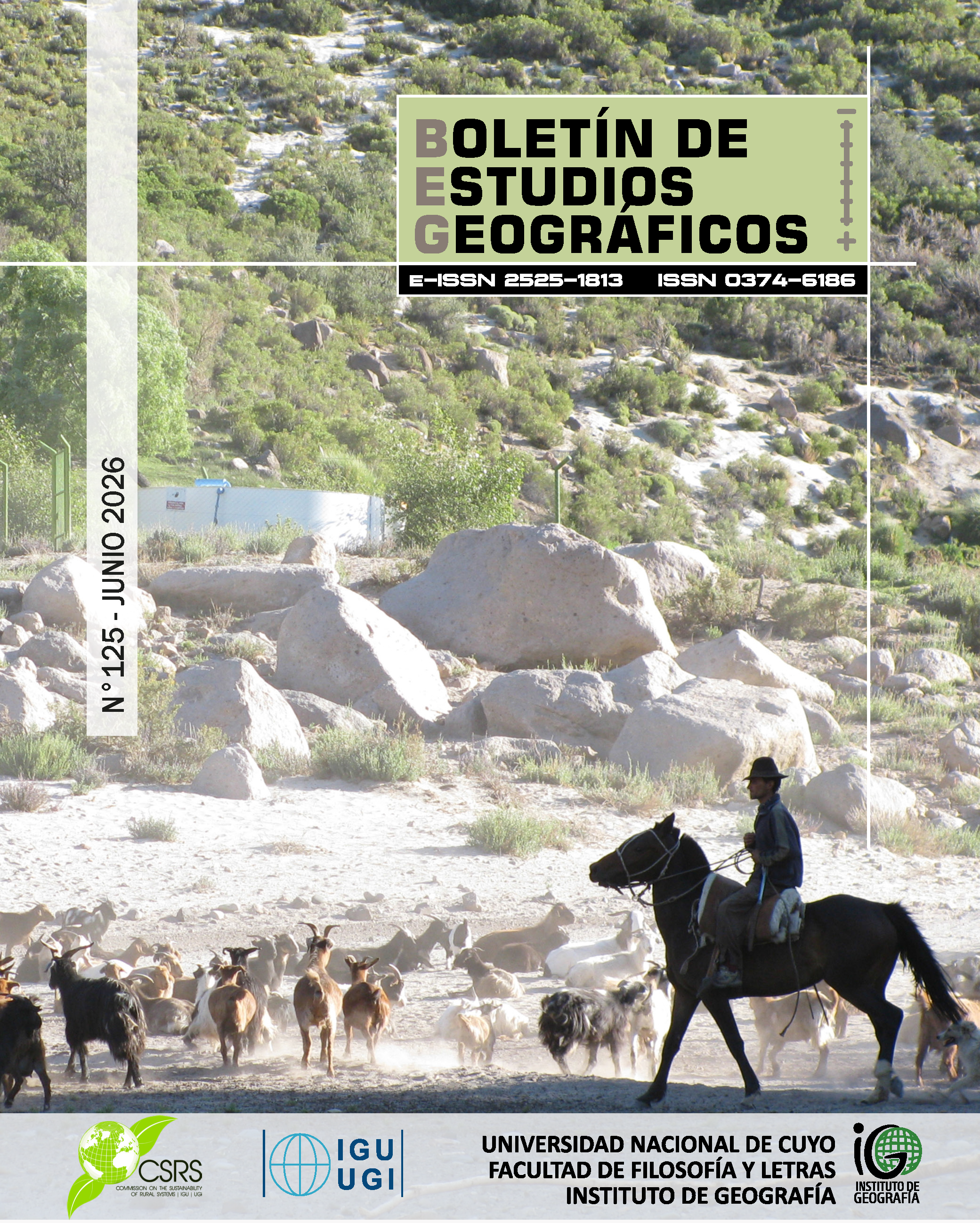
Steinhäuser, C., Lukic, A., Paül Carril, V., Ruiz Peyré, F., Haslam McKenzie, F., Lukic, A., & Martín, F. (2026). Dossier: Contested Rural Scapes. Boletín e studios Geográficos, (125), 8-22. etrieved from https://revistas.uncu.edu.ar/ojs3/index.php/beg/article/view/10211

Issue

Section

Dossier