-
526
-
316
-
299
-
208
-
183
Normas para autores
Información para autores/as
¿Está interesado en publicar en la revista? Se recomienda revisar la página Acerca de la revista para consultar las políticas de sección de la revista, así como las Directrices para autores/as. Los autores/as deben registrarse en la revista antes de realizar su envío o, si ya están registrados, pueden simplemente iniciar sesión y comenzar el proceso de cinco pasos.
Para hacer efectiva la publicación se deberán cumplir con las siguientes recomendaciones del Comité Editor:
El autor deberá enviar su artículo para su evaluación, luego de ser aceptado, deberá cumplimentar con la presentación de las siguientes notas:
Autorización de población, Ficha de publicación y la declaración de originalidad del artículo. Una vez remitidos al comité las notas, se procederá a dar difusión de los artículos.
AUTORIZACIÓN DE USO DE IMÁGENES
FICHA DE AUTORIZACIÓNPARA PUBLICACIÓN DE ARTÍCULOS
ORIGINALIDAD Y AUTORIZACIÓN PARA PUBLICAR
Formato del texto: El texto enviado deberá estar en formato Microsoft Word (doc o docx) A4. El tamaño de fuente para el cuerpo del texto es 12 puntos; La tipografía es Times New Roman. Los párrafos llevarán un espaciado interlineal sencillo. En el cuerpo del trabajo no se usarán sangrías de ningún tipo. Por lo tanto, los párrafos se separan por un espacio. Tampoco lleva cortes, ni saltos de páginas.
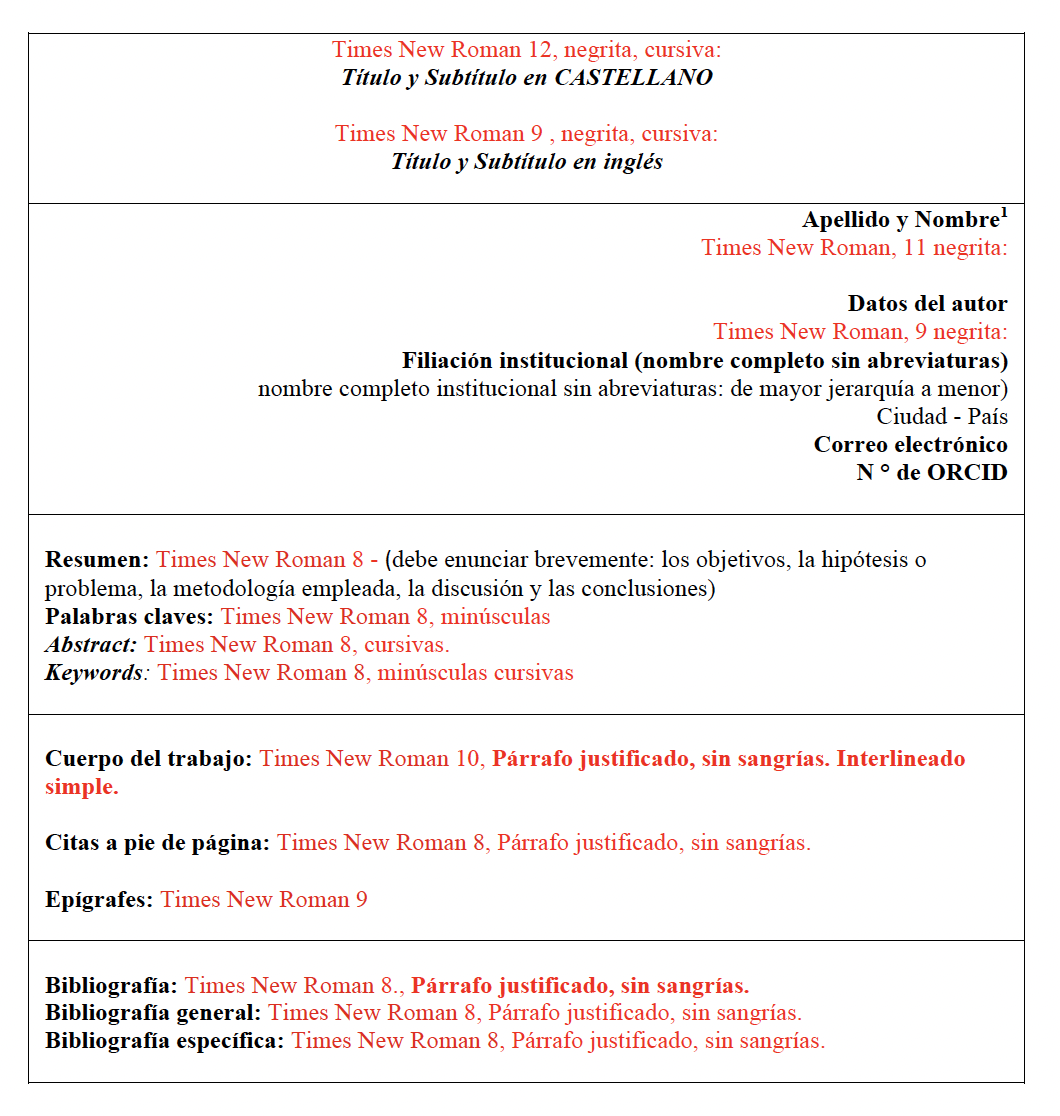
Los márgenes: superior e inferior de 2,5 cm. Y el izquierdo y derecho de 3,5 cm. No se aceptarán textos con notas al final del trabajo.
- Título en castellano centrado (Times New Roman 12 cursiva).
- Título en inglés centrado (Times New Roman 9 cursiva).
- Palabras claves: Cuatro (4) margen izquierda en minúscula, en Times New Roman 8, traducidas al inglés (la traducción al portugués, francés y ruso estará a cargo de los traductores oficiales del Instituto de Historia del Arte).
- Resumen: contará con un mínimo de 100 y un máximo de 200 palabras en un solo párrafo y aparecerá en formato Times New Roman 8 para el resumen en español y Times New Roman 8 cursiva para los resúmenes en otros idiomas. Describirá el tema del trabajo, la metodología empleada y sus conclusiones. No debe incluir interpretaciones o críticas, citas bibliográficas o referencias a figuras o imágenes del texto. Deberá incluirse una traducción del resumen a otro idioma (inglés). Si se utilizan en su redacción palabras significativas del texto esto ayudará a la recuperación en línea.
- Datos del autor: En el margen derecho constará los datos del autor (time roman 11), la filiación institucional sin abreviaturas (los nombres se detallarán completos), país, correo electrónico, todo en Times New Roman 9. Se debe colocar el N° de ORCID ID (que es un identificador digital único y permanente (ORCID iD) para distinguir su producción científica y profesional, vinculando todas sus actividades (publicaciones, premios, afiliaciones, etc.) a su perfil). A pie de página se especificará los datos personales del autor (CV) de entre 50 y 70 palabras en Times New Roman 8 y en párrafo justificado y sin sangrías.
- Bibliografía: El sistema implementado será el Chicago-Deusto, en tipografía Times New Roman 8, en párrafo justificado y sin sangrías.
Los textos: deberán ser originales e inéditos. interlineado simple para las notas a pie de página (no se aceptarán textos con notas al final del trabajo). Se organizarán en apartados cuyos epígrafes se escribirán numerados, en Times New Roman 9, centrado y en cursiva, además las páginas deberán ser numeradas correlativamente.
CITAS:
Estilo de Citas: Chicago-Deusto: Es el sistema de citas que se deberá emplear. Se emplea en notas a pie de página. La bibliografía se colocará al final del artículo (y no en el cuerpo del trabajo, por tal motivo no se utilizará el sistema autor-fecha). Es uno de los estilos más utilizado por las humanidades, literatura, historia y las artes. El sistema Chicago – Deusto se empleará en: Notas y Bibliografía.
Las notas a pie de página (citas): deberán ir con letra Times New Roman 8, deberán ser numeradas correlativamente. Se detallarán iniciando con el nombre y apellido, Título del artículo (Lugar: Editorial, año), 6-10.
Bibliografía: las referencias de cada artículo aparecerán al final del mismo, ordenadas alfabéticamente, (Times New Roman 8) apellidos de los autores y luego nombre, Título. Lugar: Editorial, año. Con interlineado sencillo.
Citas para imágenes, ilustraciones, figuras y tablas se incorporarán con sus correspondientes datos del autor o derechos de autor: es decir que al incluir una imagen propia o de otro autor se deberá insertar la imagen y luego a continación debajo se colocorá en el epígrafe los datos correspondientes (a la imagen: autor, título, fecha, etc.) y en el mismo epígrafe se señalará con nota al pie la referencia de la fuente, es decir: si es formato papel las referencias bibliográficas, y en el caso del formato virtual se debe señalar el lugar o sitio en que se aloja la imagen, es decir se debe realizar la cita web con su respectivo link.
LOS ARTÍCULOS QUE NO CUMPLAN ESTAS ESPECIFICACIONES NO SERÁN PUBLICADOS (ver: Chicago-Deusto)
* NOTA -1: Las traducciones en otro idioma (portugués, francés y ruso) son responsabilidad del Área de Traducciones de los CHA, y serán solo serán visibles en las publicaciones de los CHA. Sólo se tendrá en cuenta los títulos (en portugués, francés y ruso) para los metadatos. "El equipo editorial de los Cuadernos de Historia del arte solicita a sus autores la inclusión de título, resumen y palabras clave en el idioma original del trabajo, español e inglés de modo obligatorio. Asimismo, se reserva el derecho de incluir traducciones que considere pertinentes en otro idioma de los respectivos metadatos mencionados."
* NOTA -2: Los CHA no cobra tarifas de publicación bajo ningún concepto.
Ejemplos:
Libros: Autor o hasta tres autores, Título del libro en cursivas, (lugar de edición: editor, año), y p./pp.
Diego PRO. "El ser de lo Americano", en: Cuyo, Anuario de filosofía Argentina y Americana, (Mendoza: Instituto de Filosofía, Facultad de Filosofía y Letras, Universidad Nacional de Cuyo, 1984), 20.
Artículos:
Autor, "Título del artículo", en Título de la revista en cursiva, (lugar de edición: editorial, año), 2-44.
Citas o Notas a pie de página:
IBIDEM (sin acento): Ibidem: significa "en la misma obra". Se usa cuando es necesario citar la misma obra referenciada anteriormente o establecer que es "del mismo autor". Se emplea para citar un autor al que se ya se ha hecho referencia.
1 Erwin PANOFSKY. Arquitectura gótica y pensamiento escolástico (Madrid: La Piqueta, 1986), 24.
2Ibidem, 24.
- CIT.: Op. cit. significa: (opus citatum) en la obra citada Usado para mencionar otra página de una obra anteriormente citada, habiendo intercalación de otras referencias.
1 Josep María MONTANER. Después del movimiento moderno: arquitectura de la segunda mitad del siglo XX, (Barcelona: Gili, 1993), 43.
2 Hans IBELINGS. Supermodernismo: arquitectura en la era de la globalización (Barcelona: Gili, 1998), 123.
3 Josep María MONTANER. op. cit, 105
Citas de internet:
Lewis CAROLL , Alice’s adventures in wonderland, (Alemania: Dortmund, 1994), http://www.germany.eu.net/books/carroll/alice/html.
Normas para la utilización de imágenes: para la selección, producción y envío de imágenes y material gráfico, y que este materia se reproduzcan con buena calidad. Las imágenes que utilice los autores pueden ser: fotografías, dibujos e ilustraciones, además de gráficos, mapas, tablas, diagramas, e infografías, entre otros. Para llevar a cabo la publicación se deberá contar en primer lugar con todos los permisos necesarios (derecho del autor de las imagenes visuales). Para ello se debe entregar una lista de imágenes (en un archivo de Word) donde figure para cada imagen:
- Número (según orden de aparición) y nombre de la imagen y autor: con su correspondiente autorización. O la fuente de libre circulación (siempre que estas no se hallen sujetas a derechos de autor).
- Fuente o permiso del autor (en anexo: es decir que el autor de la obra o los propietarios de la misma deberán autorizar por escrito el uso de la misma, (se anexa formato de nota).
Las Imágenes digitales se dividen en cuatro categorías:
- Obras de arte convencional que ya han sido digitalizadas en un escáner de calidad profesional.
- Fotografías digitales de buena calidad y resolución, preferentemente tomadas por fotógrafos profesionales.
- Ilustraciones digitales, o sea, dibujos creados con programas de computación.
- Obras de producción artística.
Las imágenes deberán tener una resolución de 300 dpi y contar con las dimensiones métricas en que van a ser reproducidas. Se aceptarán imágenes en formato TIFF y JPG. No se aceptarán imágenes de baja legibilidad o de baja resolución, las mismas deberán estar en el cuerpo del texto, pero con la resolución y calidad correspondiente.
Notas obligatorias a presentar: se solicitará de los autores 2 (dos) notas en relación a las imágenes que utilicen. Una vez que al autor recibió la notificación de aprobación de su publicación, deberá enviar las siguientes notas en un tiempo máximo de 7 días a partir de la recepción de su notificación. Las presentes notas deberán ser completadas por el autor o autores para poder publicar en los CHA con sus correspondientes autorizaciones firmadas. (Las mismas deberán ser impresas y completadas con letra legible e imprenta, luego serán firmadas con azul. Una vez completada la nota se deberá escanear con buena resolución para ser enviada a la editorial).
NOTA MODELO DE AUTORIZACIÓN PARA LA UTILIZACIÓN DE IMÁGENES
|
Por la presente autorizo al Sr./a Directora del Instituto de Historia del Arte de la Facultad de Filosofía y Letras de la Universidad Nacional de Cuyo, Dra. Emilce N. Sosa a emplear las imágenes de las obras producidas por el/la artista de su autoría ....................................................................................................... Basados en la Ley 11.723 (1933), sobre Derechos Intelectuales y Derechos de Autor, para ser utilizadas en las publicaciones de carácter académico y científico del mencionado Instituto. Las mismas tendrán por fin, un uso educativo para la difusión científica siendo publicada bajo Esta obra está bajo una Licencia Creative Commons Atribución-NoComercial-CompartirIgual 3.0 No portada.
Firma del AUTOR y/ o Autorizante
|
NOTA MODELO DE AUTORIZACIÓN DE PUBLICACIÓN (Se tendrán que remitir al Comité Editor tantos formularios como autores de figuren por artículo y/o texto).
Mendoza, / / 20... A la Sra. Directora del Comité Editorial del Instituto de Historia del Arte Facultad de Filosofía y Letras UNCuyo Dra. Emilce N. SOSA S _________// _________ D
Me dirijo a Usted, en mí carácter de autor, (Apellido y Nombre)_____________________________, ______________________________________________(Nº de DNI/Pasaporte)_______________ y país___________________. Y por la presente declaro que soy autor del artículo titulado (nombre del artículo)_____________________________________________________________________, de mi propiedad, y que el mismo es original siendo el responsable por su contenido. Que el mismo no fue publicado en ningún otro formato o soporte con anterioridad. Que no ha sido enviado simultáneamente este texto a ninguna otra revista o medio para su publicación, ya sea total o parcial. Declaro que no hay conflicto de intereses. Y en caso de ser aprobado y aceptado para su publicación, permito su acceso a los protocolos, registros y fuentes de datos científicos originales en los que se funda el texto. De esta manera "AUTORIZO" al Comité Editor, que publique, e incluya el artículo a través de los distintos tipos de formatos o soportes de publicación (papel o digital), y lo registre a su nombre. Además, autorizo a que el Comité Editor pueda introducir cambios ortográficos, de puntuación en el contenido y en el estilo del texto además de las traducciones pertinentes en portugés, francés y ruso de ser necesario. Por la presente, renuncio a cualquier otro reclamo o beneficio ulterior derivado de la publicación y gestión de la obra mencionada. Declaro además, ser titular original del derecho de autor sobre mi artículo y tener derechos o las pertinentes autorizaciones para el uso de citas o fragmentos de otras obras incluidas en él. Declaro que no existe juicio, litigio o reclamo alguno pendiente respecto de mi artículo, liberando expresamente de cualquier responsabilidad ulterior a el/la los/las compilador/es y a los coeditores por cualquier infracción legal, reglamentaria o contractual que eventualmente cometa o hubiere cometido con relación a la publicación del artículo de mi autoría, que será parte del libro arriba mencionado. NOMBRE Y APELLIDO:DOCUMENTO/PASAPORTEFirma/Aclaración:Fecha: |